
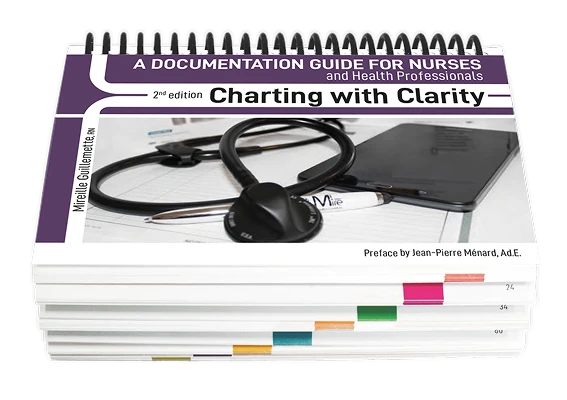
Visiting from Australia? Discover Charting with Clarity (Australian Edition)



The numerous medical prescriptions administered to patients pose public health issues today. At the heart of this 7-hour training are facts that challenge our beliefs about the administration of medications. Between a medication that saves lives and iatrogenic consumption, the nurse must, using the latest evidence-based data, exercise their scope of practice to assess the effects of medication on the patient’s health.
This training provides the tools to address the challenges and dangers posed by multiple medical prescriptions. The medication cascade, safe administration, informed consent, refusal of care, and optimal use of medication are just some of the issues raised in nursing practice in a context where half of the most prescribed medications in Canada are to be prescribed because they are ineffective or even dangerous.
Make optimal use of medication by clearly identifying the issues related to the dangers of polypharmacy.
This online training with a 6-month access period is based on evidence-based data. Very concrete, filmed interviews and case studies will be used. The training focuses on safety assessment and monitoring.
This training is particularly aimed at nurses and nurses' assistants, inhalotherapy therapists, teachers, and the management of nursing care.
General objective: To make optimal use of medication by clearly identifying the issues related to the dangers of polypharmacy.
Contents:
– What is polymedication?
– Clinical studies and the pharmaceutical industry
– Things to know to clarify consent
– What is optimal usage?
– The medicinal cascade
– To describe, is that my role?
– Refusal of care
– Security administration
You have access to your online training for 1 year.
Certified 7-hour certificate.


 French French
 English (Canada)
 English (Australia)

marcel says:
The content is very interesting, in addition to being backed by solid references. Thank you very much!
Nancy Martel says:
Very good training; it is with this training that we see that the elderly are overmedicated. I will be able to discuss this training with my colleagues. Thank you very much!
Alicia Moore-Hopkins says:
Excellent!
Réjane Racine says:
Very interesting
Réjane Racine says:
Thanks, that’s very interesting
Réjane Racine says:
Thanks for the training
Souad Talbi says:
Very relevant content, thank you
Majda Bezzaoucha says:
Thanks, that was very interesting
PHILIPPE SABY says:
What can I say, other than that I am absolutely satisfied. It was a very good training
Ibrahima Balde says:
I really enjoyed the training, which was very clear and well structured. This training will help me improve the quality of my care in the performance of my duties.