
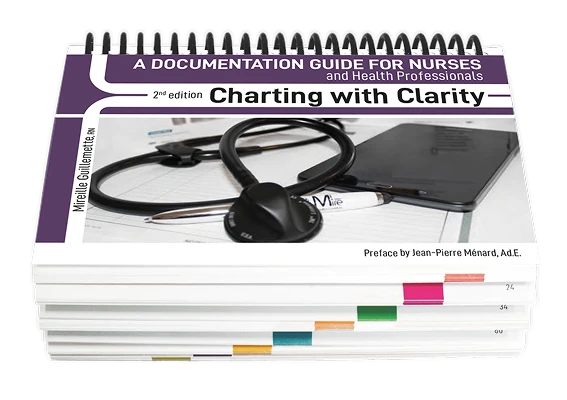
Visiting from Australia? Discover Charting with Clarity (Australian Edition)


Population aging, chronic diseases, and comorbidity are today the source of important, often unrecognized health disorders, among which the following figure prominently: delirium. It is a fairly common neuropsychiatric disorder in elderly people who are losing their independence or have several physical and cognitive impairments, but it can also affect a younger patient.
Delirium syndrome is often the tip of the iceberg of an acute health problem and presents itself as an atypical syndrome of a serious illness such as pneumonia or myocardial infarction, or as a multitude of symptoms that deteriorate the person’s state of health.
This syndrome has significant consequences for the person affected. The loss of autonomy and long-term cognitive sequelae increase the length of stay in institutions and the costs of care. Hence the importance of quickly detecting this syndrome, given that only a small proportion is detected by clinicians.
This training will review the latest scientific knowledge and the results of several research studies conducted in recent years. The prevalence of delirium, its predisposing factors, and how to detect it are at the heart of this training. How to describe this syndrome accurately and, above all, provide unambiguous terminology for assessing the mental state of the elderly is another important aspect of this training on the syndrome of delirium in geriatrics.
This online training has an estimated duration of 7 hours. You will have access to your 7-hour ACCREDITED certificate as soon as you complete all the chapters.
Main objective
To assess the mental state of a person with symptoms.
TRAINER
Mireille Guillemette, B.Ed. educator and author. President of Mire Formation Conseil inc., CEVQ (Centre of Excellence for Aging in Quebec) teacher


 French French
 English (Canada)
 English (Australia)