
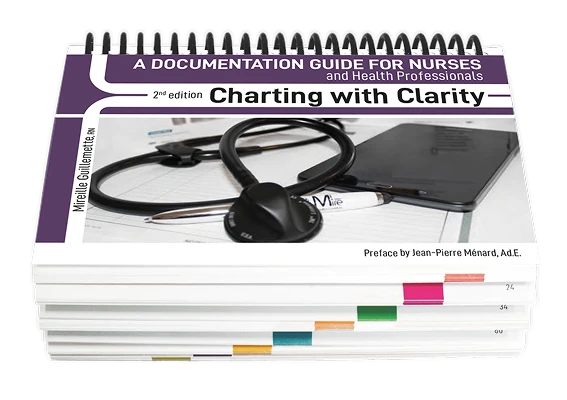
Visiting from Australia? Discover Charting with Clarity (Australian Edition)



The clinical assessment of the elderly poses many challenges for healthcare professionals today, particularly nurses. The population is aging and this places many constraints on the healthcare settings that care for this increasingly large group of older people suffering from chronic illnesses and major cognitive losses. The assessment of the physical and mental health status of these people and all the clinical decisions that result from it must be based on evidence-based data in a context where aging is heterogeneous. Knowing how to recognize the normal effects of aging and its physical and mental manifestations during clinical examination is in itself a challenge. And it is even more so when these manifestations are atypical.
The auxiliary nurse has an important role in contributing to the evaluation. She is therefore very concerned by this reality and is directly involved.
Adapt the anamnesis and clinical examination taking into account difficulties in communicating or mobilizing.
Adapting practice to the current context of care and effectively determining the severity of a condition in a person who does not present with the usual symptoms of common clinical manifestations.
Adapt the clinical examination to the available time by selecting what is most relevant for the overall clinical evaluation.
This training is based on the teachings of Philippe Voyer; the main references are his latest works. The concepts are supported by evidence-based data.
The current healthcare context means that time is often limited. A brief examination of the physical and mental condition is necessary if we want to quickly identify health problems and maintain a safe follow-up for the person.
The clinical examination must be comprehensive, precise and rigorous. The results must be recorded with precision and rigour.
In the first part of the clinical examination, either the history or the health history concerning a dominant symptom, the PQRSTU allows the collection of the minimum subjective data.
When to use the PQRSTU? When the client presents a new symptom or whenever you need to complete a partial or complete clinical examination.
Its usefulness: to remember only the minimum data to collect. Your notes will be more precise and based on a method that will facilitate a quality clinical follow-up. These subjective data collected guide the subsequent course of your clinical examination.
At the end of this training, the participant will use the PQRSTU as an effective shortcut to collect reliable and essential information at this stage of the clinical examination. Also learn to avoid questions that can bias the results by avoiding suggesting answers to the patient.
This training is aimed at nurses and nursing assistants.
You have access to your online training for 1 year.
Accredited 3-hour certificate.


 French French
 English (Canada)
 English (Australia)

Clotilde Palaku says:
Thank you very much, Mrs. Guillemette, this training was really interesting.
Clotilde Palaku says:
Thank you for everything.
Theoret says:
It was impossible for me and my colleagues to print the PowerPoint in advance. I had to complete the entire training before I could print the documents; otherwise the site wouldn’t allow us to print them.
Training: a nice update, a nice refresh of the PQRSTU.
I really appreciate the training on the elderly, the difference between normality and abnormality. The atypical signs of the elderly
it will help me a lot
Mireille Guillemette says:
Hello, thank you very much for informing me about this situation. I am sorry for the inconvenience. The problem has been resolved. Often, when you use a secure network (such as in the CISSS), it is impossible to download or print a document from outside the network. In this situation, I can send you the training document by email.
Delanoe says:
Very interesting and it’s always good to go back to basics to stay up-to-date. It has helped me a lot and many thanks again Mireille
Linda.Fortin says:
Very good training, very formative
Nathalie Poulin says:
just wow, such great energy!!!
Nathalie Poulin says:
I loved the dynamic training!!!
Roxana Ciolacu says:
Excellent training…… the only downside is that the training is better done on a computer because on a phone or tablet it’s very difficult, with a lot of errors. But in the end we’re talking about the course, which for me was an excellent help.
Mireille Guillemette says:
Hello, this problem is often caused by the fact that your web browser is not up to date. If you use Safari, Firefox or Explorer: update your browser OR download GOOGLE CHROME for free
I am glad that you have completed your training and that you enjoyed it.
Louise Larouche says:
The content of the training was clear and well-structured. This will be very useful to me in my daily work with my clients. Thank you.
Emmanuel Saladin says:
I am very satisfied with the training; I learned a lot of things and I feel better equipped to care for my residents thanks to the excellent teaching of the trainer, Ms. Mireille G.
Marie-Claude Roy says:
Thanks, the content was very informative and a «refresh» always feels good (sorry for the Anglicism)
Cynthia Bilodeau says:
Thank you very much for this training!
Lucille Lubin says:
Thanks, the content was very informative; I am satisfied with the training.
Martine Tremblay says:
Very nice training. Thank you very much.
Nadia Tahiri says:
The content of the training was very interesting. It caught my full attention.
Very nice return on this care tool.
Ahmadou Bédéwiyou Fousseni says:
Very nice improvement in the evaluation quality