
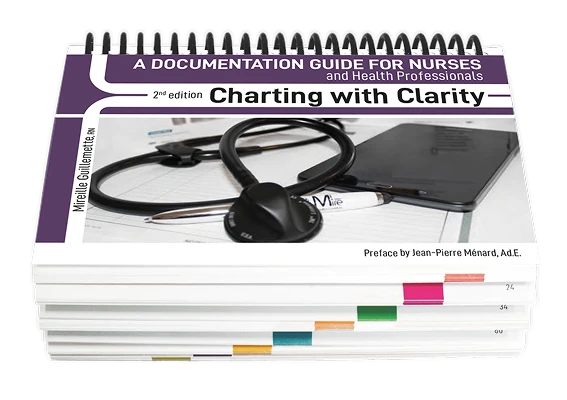
Visiting from Australia? Discover Charting with Clarity (Australian Edition)



Complex wounds represent a frequent clinical challenge in healthcare settings, particularly among an aging population with multiple comorbidities. This training aims to strengthen nursing clinical judgment to ensure rigorous assessment, effective prevention, and appropriate treatment of wounds.
The participants will deepen their knowledge of the main types of wounds encountered in practice, namely:
Pressure injuries, skin damage caused by moisture
Lower limb ulcers (venous and arterial)
Skin lacerations
Diabetic foot ulcers
From concrete clinical situations, they will learn to recognize the characteristics of each type of wound, to identify risk factors and factors delaying healing, and to adjust their interventions according to best practices.
A practical workshop on Bandages This will allow consolidating the learning related to the choice, indication and safe use of the various products, based on clinical evaluation and the evolution of the wound.
Drawing on the latest evidence, this training promotes a structured, safe, and person-centered approach. It also highlights the importance of interdisciplinary work, which is recognized for reducing the incidence of wounds, accelerating healing, and limiting recurrences.
In accordance with the reserved activities, the nurse plays a central role in the care of wounds. She is responsible for the initial assessment, the development of the treatment plan and its adjustment according to the clinical evolution. The prevention, evaluation and follow-up of wounds are therefore an integral part of her daily practice.
You are nurse This training will enable you to be autonomous in evaluating and establishing the treatment plan.
You are Auxiliary nurse This training will enable you to fully exercise your role in contributing to the evaluation and care of wounds. Are you an occupational therapist, nutritionist, or other healthcare professional?
It has been demonstrated that teamwork has a clear effect of reducing the incidence, reducing the recovery time and reducing recidivism.
In order to support the integration of learning, the training includes:
clinical case studies with photos of wounds
concrete tools for evaluation and monitoring
a practical workshop on dressings, allowing you to master the choice and use of products according to the characteristics of the wound
With a duration of 10 hours, this dynamic and applied training will allow you to develop skills that can be directly transferred to the clinical setting.
GENERAL OBJECTIVE: Apply the care techniques essential to an exemplary practice in the care of wounds.
This training will enable participants to:
Evaluate and classify appropriately treat the different types of wounds
Select the Optimal care aimed at reducing the healing time and the risk of complications
Documenting in a precise and complete way
This online training consists of:
A total of 6 hours of videos (each video is 5 to 60 minutes long)
18 quizzes (2 to 10 questions), about 60 minutes are needed to answer all the quizzes
More than 15 documents to download/view; about 3 hours are required to carefully review these documents
Trainer: Mireille Guillemette, B.Ed. nurse, author and lecturer


 French French
 English (Canada)
 English (Australia)

1ddufour says:
I am a nurse. This training is very well developed, beyond my expectations. There is a lot of explanation, the videos are of good quality and help to maintain attention and interest. The references are current, including the recent updates to the INESS guidelines. I highly recommend this training, whether you are a beginner or an experienced practitioner.