
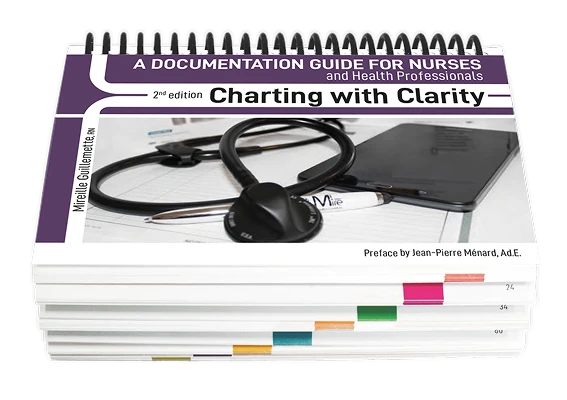
Visiting from Australia? Discover Charting with Clarity (Australian Edition)



You are looking for key information — an evaluation, a change of status, a justification for care.
And here it begins: you scroll through lines and lines of text.
Details that do not contribute anything to clinical understanding.
And the information you’re really looking for? It’s somewhere in there, buried among the rest.
Why did we end up here?
Between paper files and digital files, it often seems that «documenting well» means «writing more.» But a note that’s too long becomes difficult to read, and it dilutes the essential rather than highlighting it — which wastes valuable time for the colleague next to you, or for yourself later on.
What the standard really expects
The OIIQ documentation standard does not require a lot of writing: it requires documenting what is relevant, precise, and representative of our clinical judgment. A note can be short, telegraphic in style, and perfectly consistent, as long as it reflects our evaluation, the interventions made, and the person’s response.
Intervention: prioritizing non-pharmacological approaches
Unfortunately, I will not solve the lack of time or the complexity of the situations we face on the ground — that is part of our reality. But if this small reminder can alleviate, even a little, this heavy task of writing our notes, I will have achieved my goal.
A situation that makes you hesitate in your own notes? Write me at mireille.guillemette@mireformations.com — your questions often inspire my future content.
Mireille Guillemette, B.Éd.



 French French
 English (Canada)
 English (Australia)