
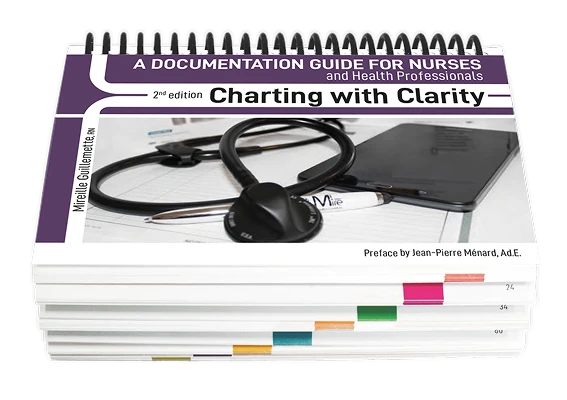
Visiting from Australia? Discover Charting with Clarity (Australian Edition)


With every heartbeat, 20 to 25 percent of the blood nourishes the brain. When you perform important concentration tasks, the brain uses up to 50 percent of its oxygen and nutrients. For the brain to function well, it must be well-nourished and well-oxygenated.http://www.alz.org/braintour/blood_vessels.asp)
I often hear: «In this family, everyone has Alzheimer's disease; it's genetics.» For more than 95 percent of people, genetics is a weakness rather than an defective gene passed down from generation to generation. When it comes to a gene, the mutation is more common than the transmission of that gene. Frontotemporal dementia (very rare), Huntington's disease, and young-onset Alzheimer's (50 years old) more often result from genetic inheritance.
ApoE, this «fragile» protein in some people, increases or decreases the risk of being affected. As for apoE4, it is impossible to perform a screening test because the risk may either be increased or decreased. ApoE3 does not affect the risk. ApoE2 reduces the risk while ApoE1 increases it.
Here are the globally recognized risk factors:
Modifiable risk factors:
*** It was believed that the brain stopped growing in adulthood. New research has proven that after 12 months of exercise, biological changes are observed: the volume of the hippocampus increases, the increase in neuron connections, new synapses, memory enhancement, and the total brain volume increase. It is never too late to start! (https://www.ncbi.nlm.nih.gov/pubmed/21282661?dopt=Abstract)
Conclusion: The life choices we make influence our risk much more than the genetic factor. This does not guarantee that we will not be affected, but it places us in the low-risk group.
Watch my next article, which will review some myths related to Alzheimer’s disease; I will also talk in more detail about depression and education.
–
Mireille Guillemette, B.Ed., president and trainer for Mire Formation Conseil inc.
–
Main risk factor: Age
Download the .pdf


 French French
 English (Canada)
 English (Australia)